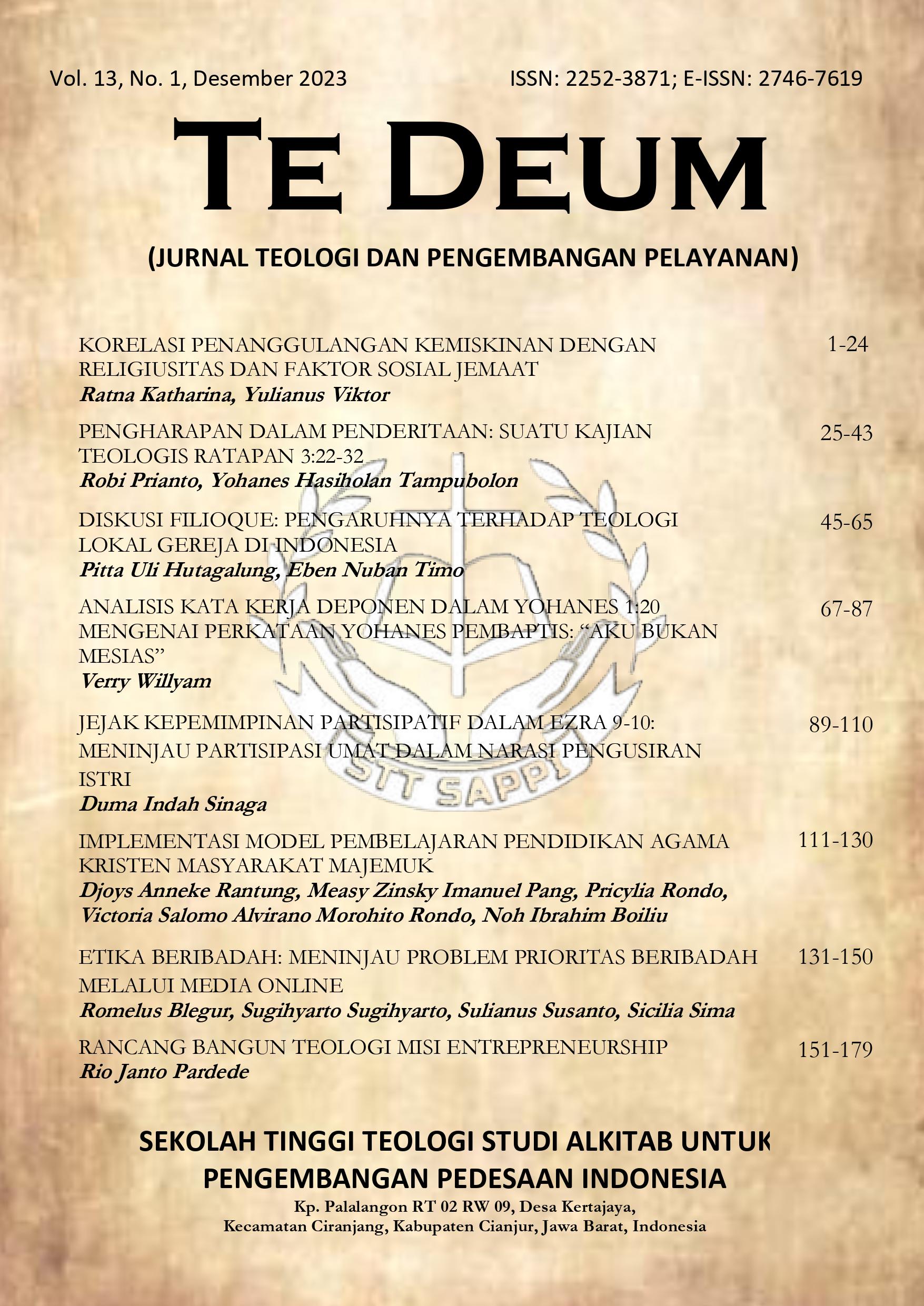
Diskusi filioque
Pengaruhnya terhadap teologi lokal gereja di Indonesia
Abstrak
Kontroversi yang terjadi antara Timur dan Barat sehubungan filioque memberi dampak yang cukup krusial. Sebut saja dampak paling jelas adalah skisma tahun 1054 antara gereja Timur dan Barat. Tetapi perpisahan itu bukan hanya bersifat teritorial, tetapi juga menyentuh perkembangan teologi masing-masing pihak. Sesuai kebutuhan konteksnya, teologi Timur dan Barat diletakkan pada pondasi yang berbeda. Timur beranjak dari pneumatologi, sedangkan Barat memulai dengan kristologi. Oleh sebab itu, berkembangnya teologi kedua pihak tentu memengaruhi teologi di berbagai tempat. Salah satunya ialah teologi di Indonesia yang bisa dikatakan memiliki keunikan. Unik karena memiliki kekayaan tradisi Timur, tetapi bercorak teologi Barat. Keunikan ini perlu dikelola dengan baik oleh gereja dalam berteologi sesuai konteksnya sendiri. Menjadi suatu keprihatinan bersama ketika gereja bersikap antipati atas tradisi konteksnya, contohnya penolakan gereja terhadap kearifan lokal. Oleh sebab itu tulisan ini hendak menguraikan suatu pemaknaan dari kontroversi filioque yang dapat menginspirasi gereja di Indonesia dalam mengembangkan teologinya.
##plugins.generic.usageStats.downloads##
Referensi
A. Titaley, John. “From Abandonment to Blessing: The Theological Presence of Christianity in Indonesia.” In Christian Theology In Asia, edited by Sebastian Kim. New York: Cambridge University Press, 2008.
Adiprasetya, Joas. “Dua Tangan Allah Merangkul Semesta: Panentheisme Dan Theenpanisme.” Indonesian Journal Of Theology 5/1 (2017).
Anatolios, Khaled. Athanasius-The Early Church Father. London: Taylor & Francis Group, 2005.
Behr, John. Tertullian, First Theologian of the West. New York: Cambridge University Press, 2001.
———. The Formation Of Christian Theology-Volume 2 The Nicene Faith-One o f the H Oly Trinity. New York: ST. Vladimir’s Seminary Press, 2004.
Berkhof, Hendrikus. The Doctrine Of The Holy Spirit. London: The Epworth Press, 1966.
Briggman, Anthony. Irenaeus of Lyons and the Theology of the Holy Spirit. New York: Cambridge University Press, 2012.
Chungman, Lee. Gregory of Nyssa, Augustine of Hippo, and the Filioque. Leiden: Koninklijke Brill, 2021.
Guretzki, David. Karl Barth on the Filioque. England: Ashgate Publishing Limited, 2009.
Habets, Myk. “Getting Beyond the Filioque with Third Article Theology.” In Ecumenical Perspectives on the Filioque for the Twenty-First Century. London: Bloomsbury Publishing, 2014.
Haynes, Daniel, ed. A Saint for East and West Maximus the Confessor’s Contribution to Eastern and Western Christian Theology. Eugene: Cascade Books, 2019.
Igusti, Chandra Robby. “Studi Persepsi Masyarakat Kristen: Perbedaan Pandang Gereja-Gereja Jabotabek Atas Roh Kudus.” Teologi Amreta 3, No.1 (2019).
Kärkkäinen, Veli Matti. Pneumatology : The Holy Spirit in Ecumenical, International, and Contextual Perspective. USA: Baker Publishing Group, 2008.
Kuiper, B.K. The Church In History. Jawa Timur: Gandum Mas, 2010.
Letham, Robert. Allah Trinitas Dalam Alkitab, Sejarah, Theologi Dan Penyembahan. Surabaya: Momentum, 2014.
Naugle, David. Wawasan Dunia-Sebuah Pandangan Kristen. Edited by Stevy Tilaar. Surabaya: Momentum, 2010.
Osborn, Eric. Irenaeus Of Lyons. New York: Cambridge University Press, 2003.
Pugliese, Marc A. “How Important Is The Filioque For Reformed Orthodoxy.” WTJ 8 (2004).
Robinson, Wheeler. The Christian Experience Of The Holy Spirit. London: Great Britain, 1944.
Russell, Norman. Cyril of Alexandria. New York: Routledge, 2003.
Siecienski, A. Edward. The Filioque-History of a Doctrinal Controversy. New York: Oxford University Press, 2013.
Surbakti, Noel.G.P.B. “Belajar Menghargai Kearifan Lokal Dari Yesus Dalam Matius 22:32.” Visio Dei: Jurnal Teologi Kristen 1 No. 2 (2019).
Victorinus, Marius. Theological Treatises on the Trinity. Edited by Mary Clark. Washmgton, D.C: CatholIc University of America Press, 1979.
Williams, Daniel. Ambrose of Milan and the End of the Arian-Nicene Conflicts. New York: Oxford University Press, 2002.
Yong, Amos. Beyond the Impasse Toward-a Pneumatological Theology of Religions. America: Published by Baker Academic, 2003.
##submission.copyrightStatement##
##submission.license.cc.by4.footer##Examples of Creative Commons Licensing Notifications in the Copyright Notices
1. Proposed Policy for Journals That Offer Open Access
Authors who publish with this journal agree to the following terms:
- Authors retain copyright and grant the journal right of first publication with the work simultaneously licensed under a Creative Commons Attribution License that allows others to share the work with an acknowledgement of the work's authorship and initial publication in this journal.
- Authors are able to enter into separate, additional contractual arrangements for the non-exclusive distribution of the journal's published version of the work (e.g., post it to an institutional repository or publish it in a book), with an acknowledgement of its initial publication in this journal.
- Authors are permitted and encouraged to post their work online (e.g., in institutional repositories or on their website) prior to and during the submission process, as it can lead to productive exchanges, as well as earlier and greater citation of published work (See The Effect of Open Access).
2. Proposed Policy for Journals That Offer Delayed Open Access
Authors who publish with this journal agree to the following terms:
- Authors retain copyright and grant the journal right of first publication, with the work [SPECIFY PERIOD OF TIME] after publication simultaneously licensed under a Creative Commons Attribution License that allows others to share the work with an acknowledgement of the work's authorship and initial publication in this journal.
- Authors are able to enter into separate, additional contractual arrangements for the non-exclusive distribution of the journal's published version of the work (e.g., post it to an institutional repository or publish it in a book), with an acknowledgement of its initial publication in this journal.
- Authors are permitted and encouraged to post their work online (e.g., in institutional repositories or on their website) prior to and during the submission process, as it can lead to productive exchanges, as well as earlier and greater citation of published work (See The Effect of Open Access).